
Mold remediation is the professional process of identifying, containing, removing, and treating mold to restore safe, natural mold levels in a home. Unlike basic surface cleaning, it addresses the full picture: containment, air filtration, removal of affected materials, antimicrobial treatment, and restoration. Most residential jobs take one to seven days depending on scope.
Quick summary:
- Mold remediation restores mold to safe, natural levels. It’s not the same as wiping down a surface.
- The EPA advises hiring a professional when mold covers more than 10 square feet
- According to FEMA, mold can begin growing within 24 to 48 hours of water exposure
- A post-remediation clearance test by an independent third party is the standard for confirming the job succeeded
Finding mold in your home is stressful. The good news is that it’s a solvable problem, and the more you understand about the process, the less overwhelming it gets. This guide covers everything: how remediation differs from removal, when to call a professional, what each step involves, and what your home looks like on the other side.
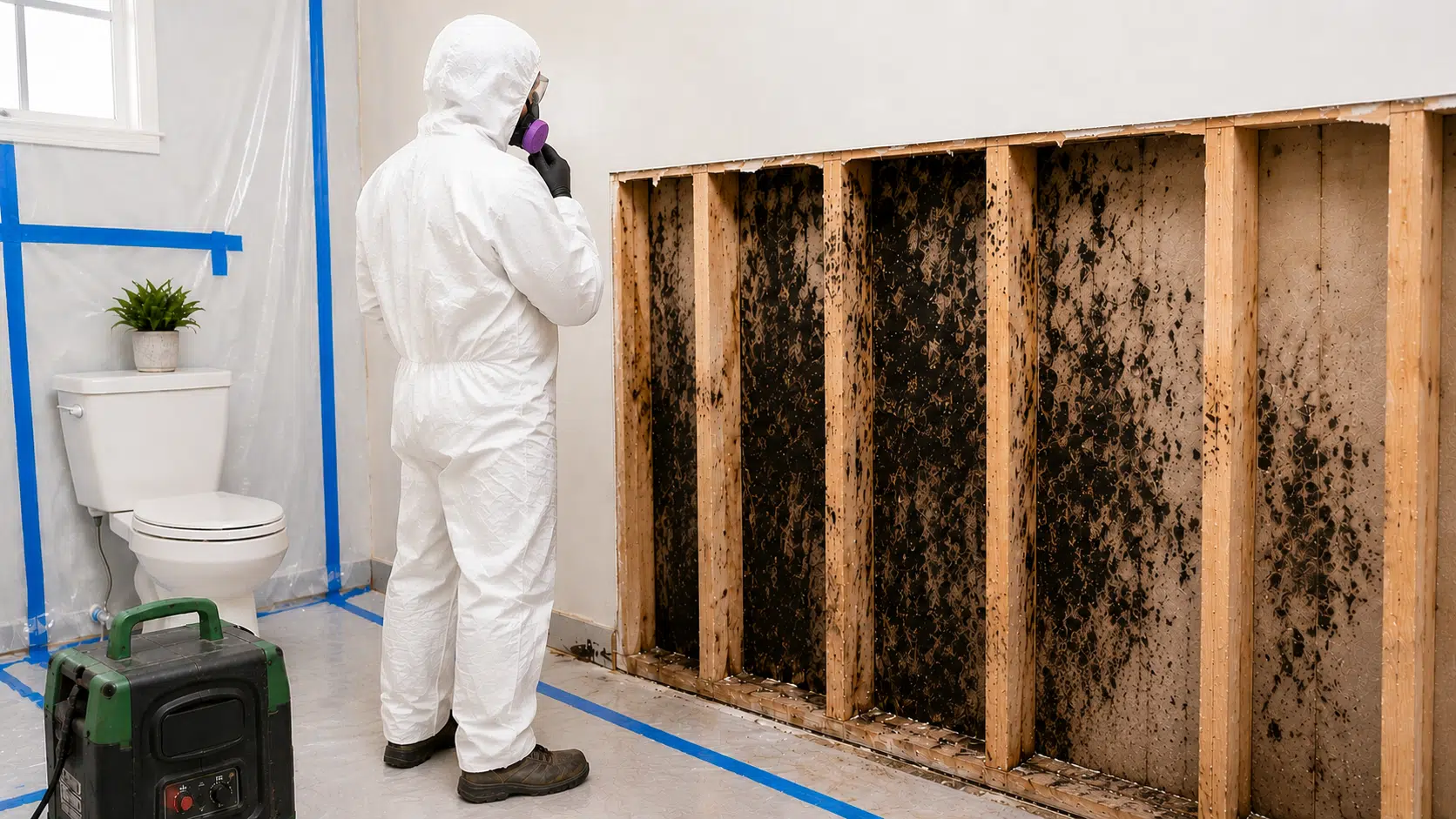
Mold remediation vs. mold removal: what’s the difference?
Mold remediation is the complete professional process of bringing mold back to safe levels: identification, containment, removal, cleaning, and restoration. Mold removal is just the physical extraction of mold-affected materials — one step within that larger process. The two terms aren’t interchangeable, and knowing the difference helps set realistic expectations.
You’ll hear both used interchangeably, but they describe different scopes of work. Mold removal sounds like it means eliminating every trace of mold. That’s not actually possible. Mold spores exist naturally in the air and on surfaces everywhere, indoors and out. The goal isn’t total elimination; it’s returning levels to safe, normal concentrations.
That’s what remediation is for. When a professional company shows up, they’re managing the full sequence: assessing the extent of the problem, sealing off affected areas, running air filtration equipment, removing contaminated materials, treating surfaces, and restoring your home. Removal is one step inside that sequence.
When do you actually need professional mold remediation?
Not every mold situation requires a professional. The EPA recommends hiring one when mold covers more than 10 square feet, when it’s in hidden or inaccessible locations, or when it resulted from contaminated water or an HVAC problem. Small surface patches on non-porous materials can sometimes be handled as a DIY project if caught early.
The line between a DIY fix and a professional job comes down to four factors.
Size. The EPA’s guidance identifies 10 square feet (roughly a 3×3 foot area) as the threshold where professional involvement is warranted. Above that, the risk of spreading spores during cleanup outweighs the savings of doing it yourself.
Location. Mold inside walls, under flooring, in crawl spaces, or in an HVAC system requires containment equipment and specialized removal techniques that consumer products can’t replicate. Without proper containment, a localized problem can become a whole-house problem.
Cause. Mold from a flood, burst pipe, or roof leak almost always involves more moisture damage than is visible. A professional assessment finds the full extent. A DIY cleanup typically doesn’t.
Health concerns. Anyone with respiratory conditions, allergies, or a compromised immune system tips the scales toward going professional, even for smaller infestations.
When in doubt, get an inspection. Reputable companies will tell you honestly when you don’t need full remediation.
Why do central Texas homes face a higher mold risk?
Central Texas homes face elevated mold risk from two compounding factors: extreme flash flood exposure and year-round heat and humidity. Together, they create conditions where mold can take hold and spread quickly after any water intrusion event.
Austin sits at the center of what the National Weather Service designates as Flash Flood Alley, the most flash-flood-prone region in the United States. The region’s shallow limestone soils and steep terrain funnel rainfall directly into fast-moving floodwater with very little warning. According to FEMA, mold can begin growing within 24 to 48 hours of water exposure. By the time floodwaters recede and homeowners get back inside, the clock has already been ticking.
Central Texas summers make it worse: intense heat and high humidity create year-round growing conditions even in homes that haven’t flooded. Any water intrusion event, whether flooding, a slow plumbing leak, or a roof gap, can turn into a mold problem faster here than in drier climates. If water gets into your home in Austin, don’t wait to act.
What does the mold remediation process look like, step by step?
Professional mold remediation follows a consistent six-step sequence: inspection and assessment, containment, air filtration, removal of affected materials, cleaning and treatment, and restoration. Each step builds on the last. Skipping any phase increases the risk of mold coming back.
Here’s what actually happens at each stage.
Step 1: Inspection and assessment
A technician conducts moisture readings, visual inspection, and sometimes air quality testing to map the full extent of the mold, establish what’s causing it, and document scope for any insurance claim. This step determines everything that follows.
Step 2: Containment
The affected area is sealed off using plastic sheeting, negative air pressure, and secured doorways. The IICRC, the Institute of Inspection, Cleaning and Restoration Certification, publishes the ANSI/IICRC S520 standard, the recognized benchmark for professional mold remediation in the US. Proper containment is central to that standard because it’s what prevents spores from spreading to other parts of the home during the work.
Step 3: Air filtration
HEPA air scrubbers and negative air machines run continuously throughout the job. They capture airborne mold spores inside the containment zone and keep them from escaping into the rest of the home.
Step 4: Mold removal
Porous materials with significant mold growth — drywall, insulation, carpet — come out because they can’t be cleaned effectively. Non-porous surfaces like concrete, metal, and tile are cleaned and treated in place. Everything removed gets bagged and disposed of safely.
Step 5: Cleaning and treatment
All surfaces in the affected area are cleaned, treated with antimicrobial solutions, and dried thoroughly. This addresses remaining mold spores and the moisture conditions that allowed growth in the first place. It’s the step most often skipped in DIY attempts. That’s also why mold tends to come back.
Step 6: Restoration
Once the area is clean, dry, and cleared, restoration begins: replacing drywall, repainting, reinstalling flooring, or rebuilding whatever was removed. Some remediation companies handle this in-house; others hand off to a separate contractor. Worth asking about before work starts.
Will insurance cover your mold remediation?
Whether homeowners insurance covers mold remediation depends on the cause of the mold, not the mold itself. Mold resulting from a sudden, covered event such as a burst pipe, appliance overflow, or accidental water intrusion is typically covered. Mold from a slow leak that went unaddressed, chronic condensation, or poor ventilation generally isn’t.
Insurance companies draw the line at sudden, accidental events already covered under the policy. Storm-related flooding is typically a separate question handled under flood insurance, not a standard homeowners policy. The inspection report your remediation company produces matters directly here: a clear, documented assessment establishing cause and scope gives your insurer what it needs to move the claim forward.
For a full breakdown of what policies cover, what they exclude, and how to navigate the claims process, read our complete guide: Does homeowners insurance cover mold damage?
How long does mold remediation take?
Mold remediation typically takes one to three days for small, contained jobs and three to seven days for moderate situations involving multiple rooms or wall cavities. Large-scale jobs with structural damage, crawl space involvement, or HVAC work can run one to two weeks or longer.
Timeline depends on the size of the affected area, what materials need to come out (drywall moves faster than structural wood), whether the moisture source has been resolved, and whether restoration work is needed after cleanup. Rushing the drying and clearance phase is the main reason mold returns after a remediation job. A company promising a fixed one-day turnaround no matter the situation is one to think twice about.
What happens after mold remediation is complete?
After remediation, a post-remediation clearance test verifies that mold levels have returned to safe, natural concentrations before the space is reoccupied. This test should be conducted by an independent third party, not the company that did the work. That independence is what makes the clearance report credible.
Once you have that report, it’s safe to return to the affected areas and begin restoration. The clearance report also serves as evidence for insurance purposes and as a clean record if you ever sell the home.
After clearance, the focus shifts to prevention. Fix the original moisture source, whether that means addressing a roof, repairing plumbing, improving ventilation, or regrading soil around the foundation. Remediation removes what’s there. Only fixing the moisture problem keeps it from coming back.
How much does mold remediation cost?
Mold remediation costs vary widely based on the size of the affected area, where in the home the mold is located, what materials are involved, and whether restoration work is needed. According to 2026 industry data, most residential jobs fall in the range of $1,200 to $3,750, with smaller surface jobs on the lower end and structural or multi-room jobs well above that.
For a full breakdown by job type, location, and cost drivers, read our complete guide: How much does mold remediation cost?
Frequently asked questions about mold remediation
It can, but it shouldn’t. When mold returns after professional remediation, it’s almost always because the underlying moisture source wasn’t fully resolved, not because the remediation itself failed. Fix the moisture cause, get a clearance test, and mold shouldn’t return.
For small, contained jobs, staying in unaffected parts of the home is often fine. For larger jobs or remediation in central living areas, most companies recommend temporarily relocating. Ask your remediation team about this before work starts. It’s a fair question and a good one.
Not always. A visual inspection and moisture assessment is often enough to establish scope and get started. Air quality testing is most useful when mold is suspected but not visible, or when a baseline is needed for insurance or legal purposes. Your remediation company can advise based on your specific situation.
Mold mitigation refers to the immediate steps taken to stop mold from spreading further, such as containment and moisture control. Mold remediation is the full process that follows, including removal, cleaning, and restoration. The terms are often used interchangeably, but remediation is the more complete description of the full scope of work.
Get a post-remediation clearance test from an independent third party. The clearance report confirms mold levels have returned to normal concentrations and the affected areas are safe. Without it, you have no way to confirm the job actually succeeded.
Ready to take the next step?
Mold is a solvable problem. Now that you know what the process looks like, from the first inspection to the final clearance report, you’re in a much better position to move through it with confidence.
If you’ve found mold in your home and want a straight answer about what you’re dealing with, we’re here to help. Schedule a free inspection and we’ll walk you through what we find and give you an honest picture of what comes next. No pressure, no surprises.